Showing posts with label 1/6TH THE KING'S (LIVERPOOL) REGIMENT. Show all posts

Thursday, October 4, 2012

1/6th Battalion The King's (Liverpool) Regiment

I was given the following information by a member of the Liverpool and South West Lancs Family History Society Forum:

"As so many of your men were 6th or 1/6th King's, is it worth a mention that their HQ was in [EDIT Upper Parliament Street  UPPER WARWICK ST], probably not quite in the parish but close enough to attract recruits? Princes Park Barracks was demolished between the wars and rebuilt, was renamed Crawford House after Sir Douglas C who was post war chairman of the West Lancs T&AFA. After the TA left it was pulled down again and is now quite different."

I've had a quick search and this website has more information about these barracks and the 1/6th King's.


Wednesday, July 4, 2012

Rifleman Henry Schonewald 1888

With such an unusual name, there was only one possible entry on the CWGC database for Henry although his surname was spelled incorrectly. His brother's name is also on the War Memorial.

*************
Henry Schonewald was born on 10th Dec 1895 in Liverpool, he was baptised in St Peter's on 20th December and the record (below) shows that his parents were Janet and Hermann Carl Schonewald (a hairdresser) they lived on Rathbone Street.

source: ancestry.co.uk

In the 1901 census the family were living at 119 Rathbone Street. The census shows that Hermann was born in Germany but was now a British Subject. Janet was from Scotland. Hermann's occupation was hairdresser and shop keeper (own account). They had 4 sons and 3 daughters at home with them. Henry was the 6th of these 7 children.
source: ancestry.co.uk


BMD records show that Henry's father Hermann died in 1909.

In the 1911 census the family were living at 75 Windsor Street (very near to St James' Church) Henry was at home, aged 15 and working as a stationers apprentice.

source: ancestry.co.uk


After the sinking of the Lusitania (May 1915) there were anti-German riots in Liverpool, in the same week that Henry was killed in Ypres, shops and houses of people with German names were being attacked.
Click here to see a post about the riots on the excellent 'Streets of Liverpool' blog.
Click here to see a post about the riots on the very informative 'Liverpool Remembrance' site.


Henry's service papers have survived. His attestation paper shows that he was in the 6th Battalion, The King's Liverpool Regiment (The Liverpool Rifles) with the regimental number 1888. He volunteered on 7th August 1914, aged 18 years and 8 months and his address at this time was 22 Peel Street (off Belvidere Road by Princes Park).
His occupation was stationers assistant at Central Stationary Co, 19 North John Street.
His height was 5ft 8inches and his weight 9st 3lbs, his physical development 'fair'

He was absent from early morning parade 7am-7:45am on 25th Nov 1914 during training at Salisbury but the punishment awarded is unclear.

Throughout the collection of papers Henry's rank is referred to as either private or rifleman. He embarked on the "SS City of Edinburgh" from Southampton on 24.2.1915 and was killed in action at Ypres on 15.5.1915. In 1919, Henry's personal effects were sent to his mother Janet and consisted of: penknife, canvas belt, chain, wallet, letters, photographs, papers, identity discs, french book, medical card.

Henry's medal card.

source: ancestry.co.uk

UK, Soldiers Died in the Great War, 1914-1919 UK, Soldiers Died in the Great War, 1914-1919


Name:
Henry Schonewold
Residence:
Liverpool
Death Date:
5 May 1915
Death Location:
France & Flanders
Enlistment Location:
Liverpool
Rank:
Private
Regiment:
King's (Liverpool Regiment)
Battalion:
6th Battalion
Number:
1888
Type of Casualty:
Killed in action
Theatre of War:
Western European Theatre


Henry Schonewald was killed in action near Zillebeke. The battalion diary for the day does not mention him by name but has detailed reports from all 4 companies of the battalion that took part in the fighting around Hill 60. Most of the casualties on that day were from German machine gun fire as the companies were moving into their positions - having to cross open ground within 400 yards of the German machine guns. On this day the battalion lost 20 men killed and 68 wounded (other ranks).

Henry Schonewald has no known grave and his name is inscribed on the Menin Gate Memorial, Ypres.

click here to see the CWGC database entry for Henry Schonewald. (his surname is misspelled as SchonewOld)

His family notified the Liverpool Echo of his death and the following notice was published:


The article mentions that two of his brothers were serving, this would have been Robert and Charles as Herman was too young. Charles hadn't gone overseas at this point so we can assume that the brother who was 'progressing favourably' was Robert. 

Saturday, June 30, 2012

Private Harold Horatio Smith 241292

A search in the CWGC database showed over a thousand results! Of these, 11 were for H. H. Smiths and 8 were Harold H Smiths.
Not all of these entries showed where they were from so I tried a different approach and looked in the index of births for Liverpool for the period 1875-1900. I found only one matching entry, Harold Horatio Smith, born in Toxteth Park in 1896. There wasn't an entry in the CWGC for Harold Horatio so I looked in the entries in UK Soldiers Died in the Great War and found only one, Harold Horatio Smith. Using his regimental number from the medal card I located his entry in the CWGC database where he was one of the H.H. Smiths.

Given the lack of another H.H. Smith born in Liverpool and the fact that this Harold H Smith was a casualty of the Great War and his CWGC entry shows that he lived in the right area of Liverpool, I am happy that this is the right man.

******************************

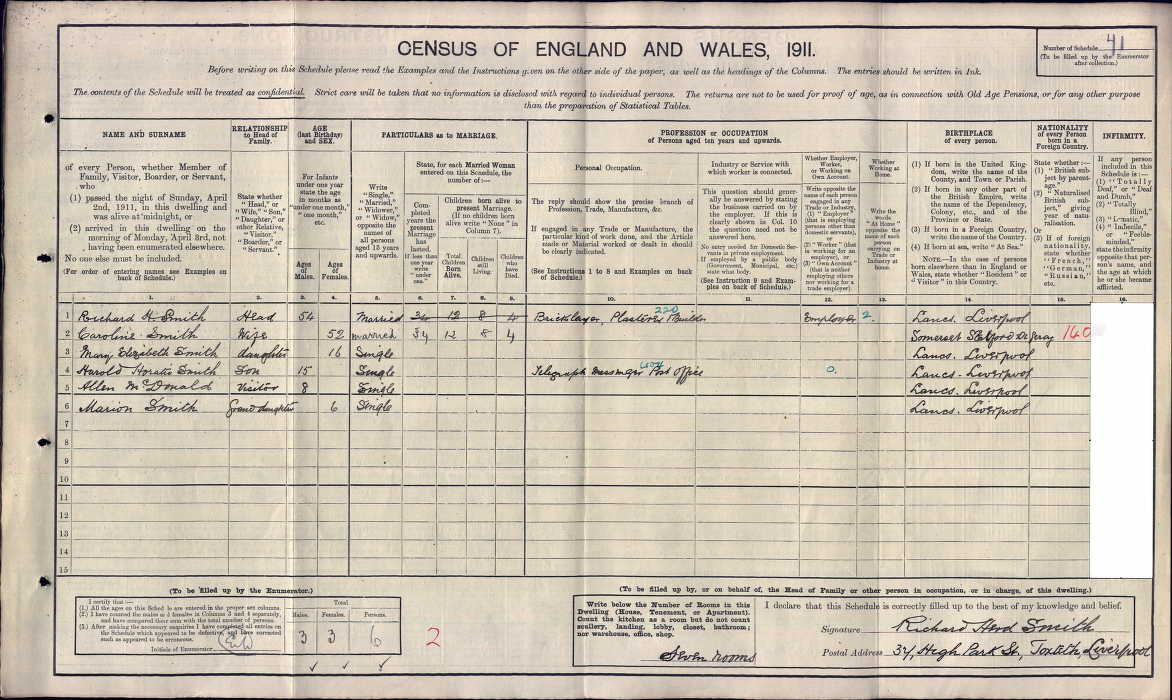
Harold Horatio Smith was born on the 2nd February 1896 in Liverpool. The record of his baptism (below) shows that he was baptised on 7th April 1896 in St Peter's, Liverpool. His parents were Caroline and Richard Herd Smith (a bricklayer) who lived on Park Road.  Harold's middle name was given for his grandfather, Horatio Smith who was from Jersey. (information from the 1891 census)

source: ancestry.co.uk

The 1901 census (below) shows the Smith family living at 155 Park Road, Toxteth Park.
source: ancestry.co.uk

In the 1911 census (below) the family were living at 34 High Park Street. Harold H Smith was 15 years old and working as a telegraph messenger for the post office. His father was at this time an employer as a bricklayer, plasterer and builder.
On a sad note, the census shows that Harold's parents had already lost 4 of their 12 children.
source: ancestry.co.uk

The medal card for Harold H Smith (below) shows that he was a private in the Liverpool Regiment with the regimental number 241292. He was awarded the Victory Medal and the British War Medal.  The card has not been completed for the theatre of war he first served in or the date, nor does it have any notes about his death.
source: ancestry.co.uk

UK, Soldiers Died in the Great War, 1914-1919


Name: Harold Horatio Smith
Birth Place: Liverpool
Residence: Liverpool
Death Date: 5 Nov 1918
Death Location: France & Flanders
Enlistment Location: Liverpool
Rank: Private
Regiment: King's (Liverpool Regiment)
Battalion: 6th Battalion
Number: 241292
Type of Casualty: Died
Theatre of War: Western European Theatre

Click here to see the CWGC entry for Harold H Smith

This information shows that Harold was in the 6th Battalion of the King's Liverpool Regiment and died on 5th November 1918.

KLR Database
The following images are from the Devereux Database, Museum of Liverpool.

Monday, June 25, 2012

Rifleman Percy Harold Harwood 240606

There were two CWGC entries for Percy H Harwood, both men were called Percy Harold but one was from Liverpool and the other from Somerset.

Percy Harold Harwood was born on 26th Sept 1895 in Liverpool. His baptism record (below) shows he was baptised on 13th October in the church of St Michael. His parents Alfred, a clerk, and Charlotte lived at 19 Parliament Place.
source: ancestry.co.uk

The 1901 census shows the Harwood family still living at 19 Parliament Place.
source: ancestry.co.uk

The 1911 census shows that the family had moved to 43 Upper Parliament Street.
source: ancestry.co.uk

Percy H Harwood's medal card showsa that he was a private in the Liverpool Regiment with the regimental numbers 2250 and 240606, he was then a rifleman in the Liverpool Regiment with the regimental number 240606.
source: ancestry.co.uk
the card also shows that he first entered the theatre of was on 24/2/1915 in France. The card shows that he was entitled to the Victory Medal, British War Medal and the 1915 star. It bears a note that he is deceased.

Percy H Harwood's entry in UK Soldiers Died in the Great War 1914-1919 gives the following informtion:


Name:
Percy Harold Harwood
Residence:
Liverpool
Death Date:
19 Sep 1916
Death Location:
France & Flanders
Enlistment Location:
Liverpool
Rank:
Private
Regiment:
King's (Liverpool Regiment)
Battalion:
6th Battalion
Number:
240606
Type of Casualty:
Killed in action
Theatre of War:
Western European Theatre


There is a slight discrepncy in that he was listed as a private here but rifleman on his medal card and on his CWGC entry. He was in the 6th Battalion of The King's (Liverpool Regiment) at the time of his death so rifleman is correct.


Saturday, June 23, 2012

Private Isaac Lucas Hilton 242828

Isaac Lucas Hilton was born on 5th April 1877 and baptised in St Thomas' Church, Liverpool on 20th Nov 1877. The baptism record show his parents were Thomas and Jane Sophia, they lived in Gower St and Thomas was a porter. The baptism was private and a notation shows that Isaac was received into the church on 17th Sept 1879.

source: ancestry.co.uk


In the 1881 census, the Hilton family were living at 2 Gower Street. Thomas Hilton was working as a warehouseman and they had 5 children.

The 1891 census return Isaac Lucas Hilton, aged 14 was working as a Master Carter's Office Boy.  Some children from the previous census were not on the 1891 census although they now had 6 children.
source: ancestry.co.uk


Isaac married in 1897 to Elizabeth Ann Elston, in the 1901 census they were living at 23 Grey Street with their daughter Edith and a boarder.
1901 census source: ancestry.co.uk

In the 1911 census Isaac and Elizabeth were living at 13 Newton Street. Isaac misunderstood the form and filled in the names of all his children, living and deceased. Sadly, 3 of their 5 children died and their names were crossed out. Newton Street was very close to St James Church, running between Windsor Street and Wesley Street.
1911 census source ancestry.co.uk

(Checking Isaac's parents on the 1911 census shows they were still both alive and living at 166 Northumberland Street,  presumably over a shop as Thomas's occupation was shopkeeper, own account working at home and Jane Sophia was working at home, two of their daughters were also with them and working in the shop.)

WW1

The medal card for Isaac L Hilton shows that he was in the Liverpool Regiment as a private with the regimental number 242828

Isaac was killed in action on 27th June 1917

Information from UK Soldiers Died in the Great War 1914-1919:


Name: Isaac Lucas Hilton
Birth Place: Liverpool
Residence: Liverpool
Death Date: 27 Jun 1917
Death Location: France & Flanders
Enlistment Location: Liverpool
Rank: Private
Regiment: King's (Liverpool Regiment)
Battalion: 6th Battalion
Number: 242828
Type of Casualty: Killed in action
Theatre of War:
Western European Theatre

Source: ancestry.co.uk

Wednesday, April 18, 2012

Rifleman Henry Percy Clarke 1220

Henry Percy Clarke


Henry P Clarke was born in Liverpool on 13th May 1894 and baptised in St Philemon's Church, Toxteth on 11th July that year (see below)


Name:
Henry Percy Clarke
Birth Date:
13 May 1894
Baptism Date:
11 Jul 1894
Parish:
Toxteth St Philemon
Father's Name:
William Clarke
Mother's name:
Mary Jane Clarke

Source Citation: Liverpool Record Office, 283 PHI/2/2.

In the 1901 census the Clarke family lived at 41 Pinehill St in the Princes Park area of Toxteth Park, Liverpool. Henry's father William Clarke was a joiner. Henry was 6 years old and had a brother William Alfred who was aged 5.

In the 1911 census the Clarke family lived at 2 Wesley St (just a few streets away from St James' Church) William Clarke was now working as an 'Engineers' Pattern Maker' Mary Jane was a dressmaker (own account) and Henry was an apprentice ship wright.

The census also shows us that William and Mary had been married for 20 years and had 2 surviving chidren from 3. Their house had 9 rooms so was quite large for 4 people.

*********MILITARY SERVICE***********

Fortunately, Henry Clarke's service papers survive and they show that
Henry Percy Clarke joined the Territorial Force 6th Battalion King's (Liverpool Regiment) aged 17 years and 2 months on 3rd July 1911. He signed up for four years. Being in the Territorial Force meant that Henry had agreed to undergo a certain amount of training and drill each year. As a Territorial he would be called up for home service in times of National Emergency.

His regimental number was 1220 and he was in 'B' Company of the 6th (Rifles)Battalion, The King's (Liverpool Regiment)

He put his occupation as apprentice (not bound) shipwright at Cammell Lairds in Birkenhead. Here is  a close-up of his signature:

Source: Ancestry.co.uk


Henry's medical report shows that he was 5ft 8inches tall with good vision and of good physical development. His chest measurement fully expanded was 35 inches with an expansion of 4 inches.

His family, listed his next of kin, were his parents and brother all still living at 2 Wesley Street.

When war was declared in August 1914 Henry Clarke would have been mobilised for full-time (home) service with the Territorial Force.  On the 19th October 1914 he signed army form E 624 agreeing to be posted overseas. At this time was was stationed at Seven Oaks, Kent.  He had served 3 years and 3 months with the Territorial Force. 

Henry embarked for France on the SS City of Edinburgh on 24th February 1915
(The SS City of Edinburgh, date unknown, source www.photoship.co.uk)
The City of Edinburgh was a steamship built in Liverpool in 1899 and originally named Maplemore then sold in 1901 and renamed, then used as a troopship 1914-1918. It was scrapped in 1929.

Less than 2 weeks later he was killed in action on 8th March 1915. Just  2 months before his 21st birthday.
Source: Ancestry.co.uk
The file of Henry's papers includes some correspondence from 1919 between Henry's parents, the Imperial War Graves Commission and the Officer i/c records about where Henry was buried, it seems that his parents asked where he was buried and were given the answer 'Behind trench B32, Ypres' which came from Henry's service record. Then both the Officer i/c of records and the Imperial War Graves Commission wanted to know where the information came from.


The CWGC database shows that Henry's name in on the Menin Gate Memorial. This means that his body was not identified after the war and reburied in one of the cemeteries, either his remains were destroyed by the subsequent fighting in the area or they were recovered but not identified and lie in a CWGC cemetery as an unknown British soldier, Known Unto God.

The following is Henry's entry in the UK Soldiers Died in the Great War

Name:
Henry Percy Clarke
Birth Place:
Liverpool
Residence:
Liverpool
Death Date:
8 Mar 1915
Death Location:
France & Flanders
Enlistment Location:
Liverpool
Rank:
Private
Regiment:
King's (Liverpool Regiment)
Battalion:
6th Battalion
Number:
1220
Type of Casualty:
Killed in action
Theatre of War:
Western European Theatre
Source: Ancestry.co.uk

The Battalion War diary  shows that the battalion were at VLAMERTINGHE until the 7th March when they were moved to YPRES. The following entry is for the day Henry Clarke was killed. He undoubtedly is one of the 'other ranks' mentioned.

YPRES 8/3/1915
HQ Ors D Coy moved from VLAMERTINGHE to YPRES. Paraded at 2pm. Battalion quartered in Calvalry Barracks. Casualties in trenches 'B' Coy Other Ranks 2 killed 7 wounded.
(source: King's (Liverpool Regiment) 6th Battalion War Diary, National Archives)

At this time the Battalion was part of the preparations for the second Battle of Ypres.


Monday, April 16, 2012

William Edwin Noll 48558 formerly 4511

William Edwin Noll

Born 10th October 1893 in Liverpool to Mary and Edwin Noll. William was christened on 1st November 1893 in St James’ Church, Toxteth, the christening record shows that the family lived at 50 Chester Street and Edwin was a mariner.

At the time of the 1901 census William was with his mother, his sister Elsie and his brother Redvers at the house of his maternal grandmother Mary Mercer at 12 Gwendoline St.

The 1911 census shows the family were still at this address but Mary Noll was the head of household (although listed as 'wife', Edwin was away at sea but still head of the household so they left a blank line for him) William had gained a sister, Mabel, and his maternal grandmother was also with them.

William worked as a clerk at the Cotton exchange, the photo on the right was probably taken when he got that job. I am told that his family were very proud that William became a Clerk.

On 28/11/1915  William enlisted in Liverpool as Rifleman (equivalent to private) No 4511 in the 6th Battalion The King's (Liverpool) Regt known as the Liverpool Rifles. 

The Liverpool Rifles, along with the Liverpool Scottish, were known as the more prestigious Battalions and they performed an important role in wartime recruitment by attracting middle-class recruits. They were also an important mixing point for the lower middle-classes (such as William in his Clerical position) with their social superiors. Before the war the 6th Battalion were known as the 'cuff and collar battalion'.

After a period of training the battalion embarked at Folkestone for Boulogne on 15/9/16, joining 24 Infantry Base Depot two days later.

On 24/9/16 William was transferred to 13th Battalion, The Kings (Liverpool) Regiment with the new regimental No 48558. William stayed with the 13th until he was killed in action on 28/3/18.  He has no known grave and his name is commemorated on the Arras Memorial.

Arras Memorial.
Photo Amanda Taylor


William's name on the Arras Memorial
Photo Amanda Taylor

link to William's entry in the CWGC database (opens in new window)


The day that William was killed was a dramatic battle for the 13th KLR, the battalion diary shows that they repeated fought off enemy attacks and held their line until finally, with no reinforcements available, they had to withdraw.

link to the 13th Battalion The King's (Liverpool) Regiment war diary for the day William died. 28/03/1918 (on this blog, opens in new window)

The following image is of William's bible which was sent back to his mother after his death. The inscription reads


Nov 12th 1916

Whoever finds this return to my home address 12 Gwendoline St, Windsor St, Liverpool to my mother Mrs E Noll who was the best mother a chap ever had.

Signed W Noll 12/9/16

God Bless them all a[t] home also my sweetheart. Wm


photo Amanda Taylor


Sgt Hugh Stanhope Elliott 240091

Hugh Stanhope Elliott

There was only one Hugh S Elliott in the CWGC database and he was in the King's (Liverpool) Regiment so I am confident that it is the right man.

Born 12th January 1892 in Liverpool and baptised 10th April of the same year, the baptism record (below) shows that his parents were John and Elizabeth of Adelaide Road and John's occupation was plumber.
Adelaide Road was in the Kensington area of Liverpool.

bapptism record Source: Ancestry.co.uk
In the 1901 census (below) Hugh was 9 years old and living with his parents and 6 brothers and sisters at 36 Alfred Street. His father is a Plumber and working on his own account. It is interesting to note that 2 doors down is a Master Plumber who is an employer.

Alfred Street was very close to St James' Church, in the area that is now the Anglican Cathedral and student housing.
1901 census Source: Ancestry.co.uk
In the 1911 census (below) the family were living at 16 Streatham Avenue, Hugh was an apprentice plumber, persumably with his father who was working as a 'hot water engineer'
1911 census Source: Ancestry.co.uk

This medal card for Hugh S Elliott shows that he was in the Territorial Force of the 6th Battalion The King's Liverpool Regiment with the regimental numbers 1181 and 240091. He held the rank of Private, then Sergeant. He was eligible for the British War Medal, the Victory Medal and the 1915 Star.
The card also shows that the 'Theatre of War first served in' was France from 24/2/1915 and it bears the remark 'deceased' but no date.
Source: Ancestry.co.uk

The CWGC certificate for Hugh shows that he was in B company of the 1st/6th Battalion, The King's (Liverpool Regiment) (The Liverpool Rifles)and he died on
20th September 1917 aged 27. (He was actually 25)


His entry in UK Soldiers Died in the Great War 1914-1919 gives the following details:
(Source: Ancestry.co.uk)

Name:
Hugh Stanhope Elliott
Birth Place:
Liverpool
Residence:
Liverpool
Death Date:
20 Sep 1917
Death Location:
France & Flanders
Enlistment Location:
Liverpool
Rank:
Sergeant
Regiment:
King's (Liverpool Regiment)
Battalion:
6th Battalion
Number:
240091
Type of Casualty:
Killed in action
Theatre of War:
Western European Theatre

The War Diary for the 1/6th Battalion:
VLAMERTINGHE, Old British Front Line
20/9/17 (Z day)
165 Brigade attack Germen line from 100 S of KANSAS CROSS to a point 100 E of WATEREND HOUSE with 9th KLR & 7 KLR to take first objective & 6th KLR and 5th KLR to take GREEN LINE - zero hour 5:40am the 9th & 6th KLR became heavily involved in the fight for HILL 35 which was finally captured after a stiff fight, the 6th consolidating strong points on HILL 35 including LENS. Major Gordon & Capt Phillips wounded while reorganising the line for further advance. Capt Eastwood, 2 Lt N.R. Phillips, 2 Lt Spratt were killed on Hill 35. 2 Lt Wallington & all No 1 Platoon of 'A'Coy were killed in a gallant attempt to capture a strongpoint to the South of Hill 35. The 1/5 Loyal North Lancs & the 1/5 South Lancs having come up to reinforce HILL 37 was captured by them and the survivors of the Battalion. Towards dusk a strong enemy counter attack on Hill 37 was beaten off with heavy casualties to the enemy.